
Pepper Spray vs. Security Fog: Which Is Better for Retail Loss Prevention in South Africa?
South African retailers lose somewhere between R8 billion and R10 billion a year to shrinkage, according to the Consumer Goods Council of South Africa, with shoplifting spikes of around 20% in provinces like Gauteng and the Western Cape in recent years. If you run loss prevention for a retail business, you’ve probably already looked at more than one type of deterrent to try and bring that number down. Two that come up a lot are pepper spray security systems and security fog.
They work in completely different ways, and it’s worth comparing them honestly rather than just picking whichever one sounds more dramatic. This post looks at where pepper spray systems make sense, where they fall short on a retail floor, and why fog has become the go-to active deterrent for retailers across South Africa.
What Is a Pepper Spray Security System?
A pepper spray security system, sometimes sold as a home pepper spray system, a vehicle pepper spray system, or an alarm-triggered pepper spray system, uses a pressurised canister of a chilli-based irritant that’s either deployed by hand or triggered automatically by an alarm signal. Pepper spray security is a well-known personal defence tool, and in South Africa it’s legal to buy and carry without a licence or permit. It has a solid track record for home and vehicle protection, where you’re dealing with a single, close-range threat and a person who can decide in the moment whether to use it.
That legality is worth being clear about, because it does change the conversation compared to some other markets. But legal to carry for personal defence and suitable for an automated retail deterrent are two very different things, and that’s really where this comparison gets interesting.
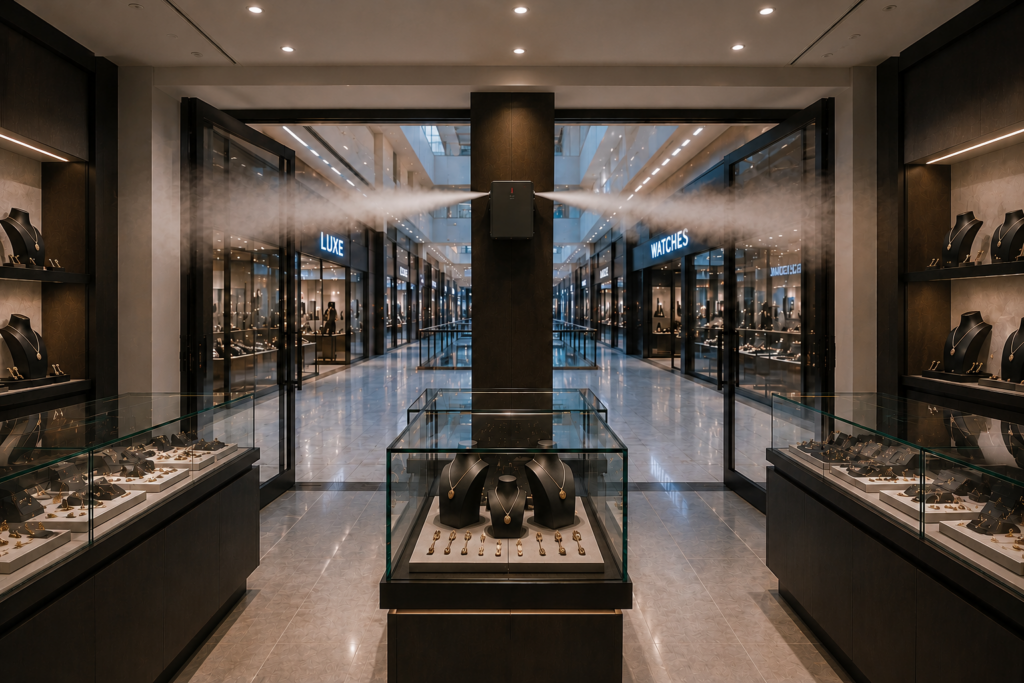
Where Pepper Spray Has a Legitimate Role
To give credit where it’s due, pepper spray systems exist because they solve a real problem well in the right setting. A car pepper spray system or a home pepper spray system triggered by a door sensor can be a genuinely effective, low-cost deterrent for a single entry point or a vehicle interior, where the space being defended is small and there’s a person on hand to use good judgement about when to deploy it.
That’s a very different scenario to a retail floor with multiple entrances, dozens of customers and staff around at any given time, and a system that has to make a call automatically with no human judgement involved.
Why Pepper Spray Doesn’t Translate Well to Retail
Even with pepper spray being legal here, chilli pepper spray security systems run into real problems the moment you try to scale them up from “one room, one person” to a busy shop floor.
Proportionality and liability. South African law is clear that any use of force in self-defence has to be necessary, directed at the actual threat, and proportionate to it. An automated system that discharges an irritant at anyone crossing a sensor, which might be a genuine shoplifter, might be a confused customer or a member of staff, sits in shaky legal ground and opens the business up to real injury liability. Eye irritation, breathing difficulty, and allergic reactions are all recognised risks of capsaicin exposure.
Bystander risk. Pepper spray doesn’t know the difference between an intruder and everyone standing nearby. In a shop full of customers, one activation aimed at a single person can easily affect several innocent bystanders at the same time.
Limited coverage. A pepper spray canister is built to affect one person or a small area at close range, not to fill a shop floor of several hundred square metres. It’s the wrong tool for covering multiple exits or a large retail space.
Manual redeployment. Once a canister has discharged, it needs to be refilled or replaced, and depending on the system, staff may need training on how to do that safely. That’s an ongoing cost and an ongoing safety consideration that a busy retail operation doesn’t really need.
What Is Security Fog?
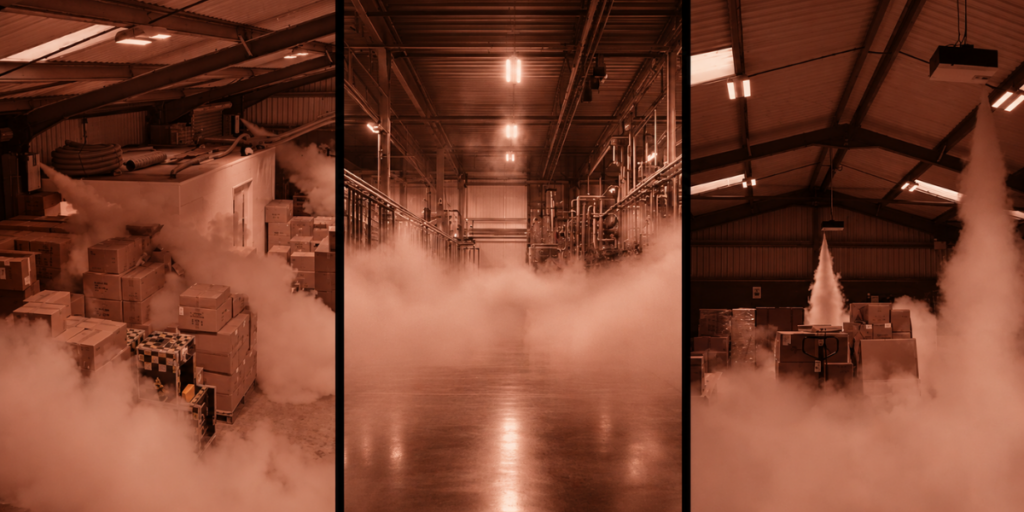
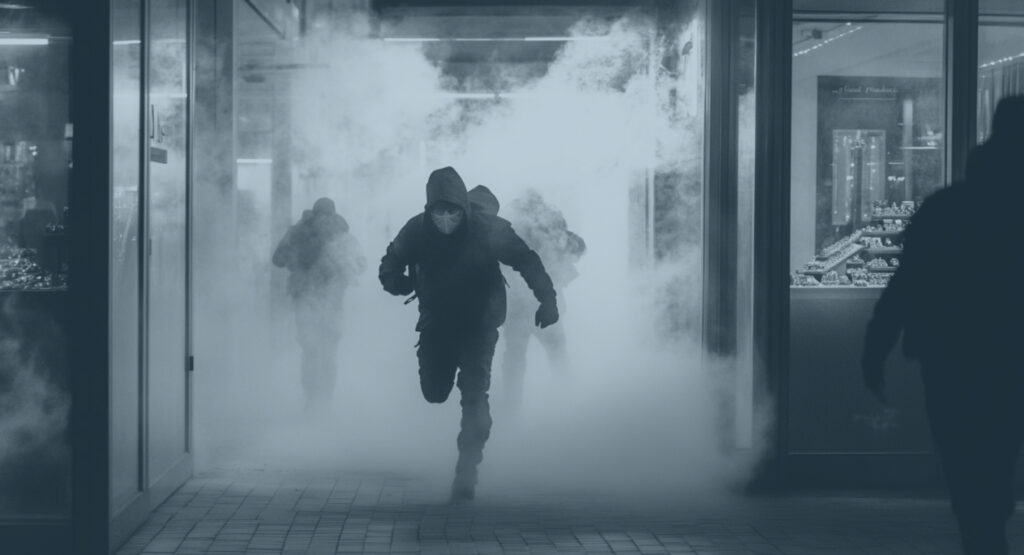
Security fog is an automated deterrent that fills a protected space with a dense, harmless fog within seconds of an alarm being triggered, usually wired directly into the existing intruder alarm so there’s no separate system to arm. Concept Smoke Screen has been building these systems for thirty years, and the idea behind them is simple. An intruder who can’t see can’t reliably find stock, staff, tills, or the way out, and the shock of a room suddenly filling with fog is, on its own, a strong deterrent to carrying on with whatever they came to do.
Unlike an irritant spray, security fog has no capsaicin or chemical component in it. It’s a dense visual obscurant rather than something that causes a physical reaction, designed to disorient and put people off rather than hurt anyone caught in it.
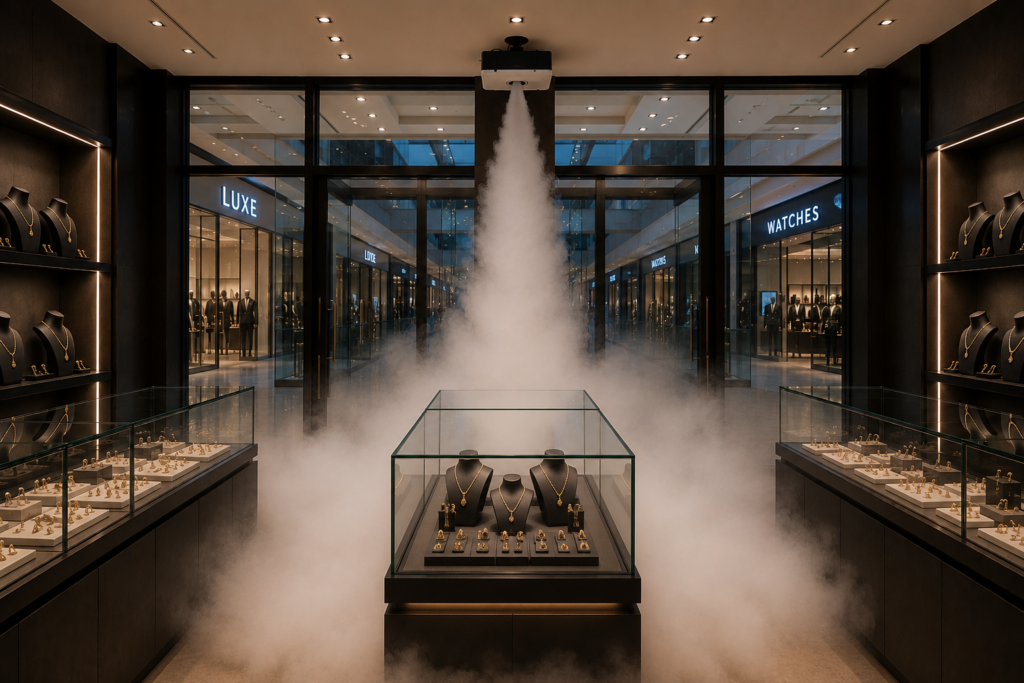
Security Fog Advantages for Retail
It covers the whole space automatically. Fog fills the entire protected area within seconds of being triggered, no manual aiming, no line of sight needed, and no staff member has to be present or make a decision in the moment.
Lower legal and liability risk. Because fog is a purpose-built deterrent rather than a chemical irritant, it doesn’t carry the same proportionality and injury-liability questions that come with using pepper spray on an automated basis in a retail setting.
Less risk to bystanders. Fog works by obscuring vision, not by causing pain or irritation, so anyone caught in it, staff or customers included, isn’t physically affected the way they would be by an irritant spray.
No manual trigger needed. Once it’s wired into the alarm system, deployment doesn’t depend on someone being present, reacting fast enough, or aiming correctly. However, you can also add a panic activation in addition to it being connected to your alarm for additional deployment possibilities.
Predictable running costs. Ongoing costs come down to fluid replenishment rather than replacing canisters or cartridges, which makes maintenance and rental arrangements straightforward for installers.
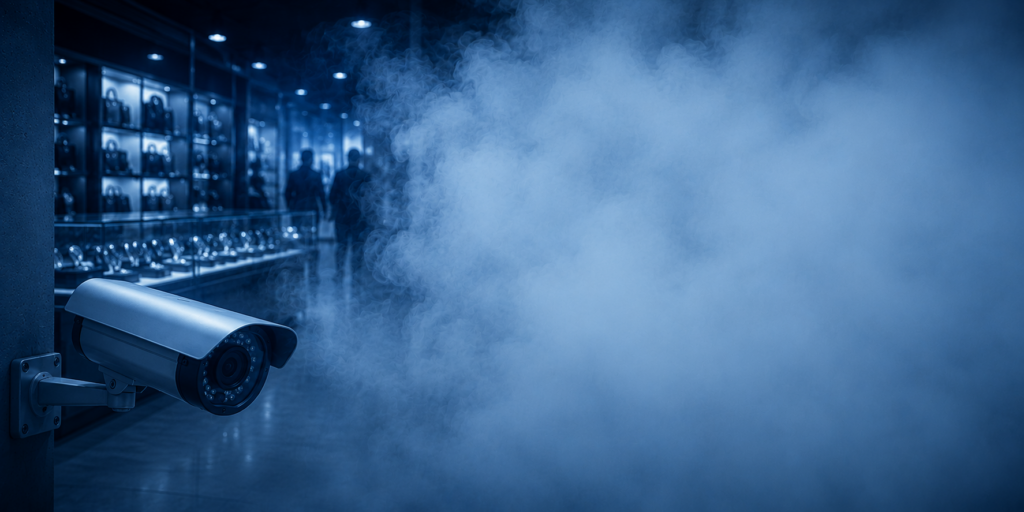
A proven track record in retail. Security fog has a long history of use in South African and UK retail settings, particularly in jewellers, pharmacies, and convenience stores where high-value stock or cash sits close to an entrance.
What Happens After a Security Fog Activation?
One question retailers often ask is what happens once the incident is over. Unlike pepper spray, which leaves behind a chemical irritant that may require specialised cleaning and ventilation before the area can be safely reoccupied, security fog is designed to be straightforward to clear.
Once the premises have been secured, the fog naturally dissipates with normal ventilation. The fluid is formulated to leave little to no residue when the system is installed, maintained and operated correctly, meaning retailers can usually return to business far more quickly than they could after an irritant-based deployment. In most cases, any surfaces that do require attention can simply be wiped down as part of normal housekeeping. Because security fog works by denying visibility rather than causing discomfort, there’s no need to decontaminate the area for customers or staff before reopening. That means less disruption, faster recovery after an attempted theft, and a simpler post-incident process for store managers.
Head to head comparison

Real-World Scenarios
- Small single-entry shop. A personal pepper spray device might suit a lone staff member’s own safety, but it’s not a substitute for a whole-premises deterrent, and it’s not really designed to be wired into an alarm system as an automated trigger.
- Multi-entry supermarket or convenience store. Security fog covering tills and stockrooms gives you automated, whole-space coverage that a single-point irritant device just can’t match.
- Jewellers and high-value retail. Fog deployed near display cases and safes takes away visibility during the exact seconds that matter most in a smash-and-grab.
- After-hours warehouse or stockroom. An automated fog trigger covers the space without needing anyone on site to operate it.
Cost and Return on Investment
Pepper spray systems often look cheaper upfront, but for a retail business that calculation needs to include potential liability if the system is used on the wrong person, plus the ongoing cost of staff training and canister replacement. Security fog’s costs are more predictable, an installation cost that ties into your existing alarm system, and a recurring fluid cost that scales with how often it’s actually used rather than with each individual incident. When you weigh up the full cost of ownership rather than just the sticker price, fog is a much easier system to budget and insure for.
Talk to Smoke Screen
If your current setup relies on point-source deterrents that don’t really scale to your retail floor, or you’re weighing up your options and want a system with a genuine, long-standing retail track record, Smoke Screen can assess your premises and talk you through where fog fits with your existing alarm system.
- Book a retail security assessment
- See a live security fog demonstration
- Speak to a loss prevention specialist about deployment zones for your floor plan
Courtney Tupper