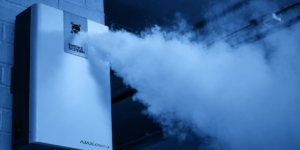

Is Security Fog Safe?
Quick answer: Yes. Fog is safe, but ensure you’re getting fog, and not smoke, and ensure you’re buying what the manufacturer claims to be selling. Certified security fog is a vapour of food-grade glycol and water — non-toxic, non-irritant, safe to breathe, safe around children and pets, and it leaves no residue on stock, fabrics or electronics. Systems certified to EN 50131-8 are tested specifically for safe deployment in occupied premises. The fog stops burglars by removing visibility — nothing else in the room is affected.
“It fills the room in seconds — is that actually safe?” is the most sensible question anyone asks about security fog, and the reason this technology is trusted in pharmacies, food warehouses, banks and family homes is that the answer holds up under every version of the question. Here they all are.
What security fog is made of
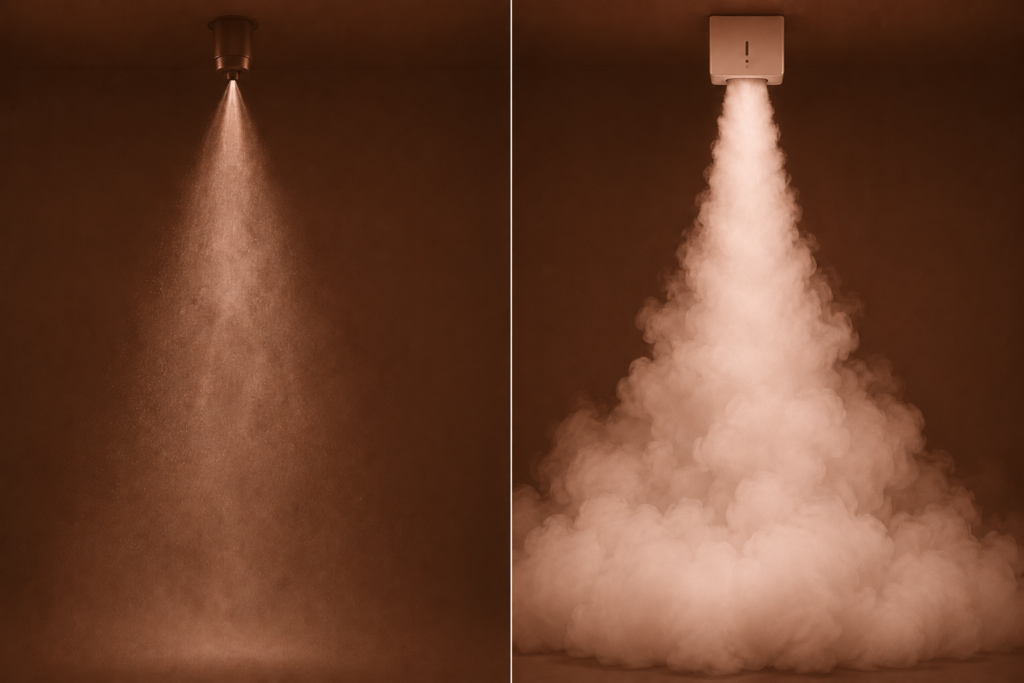
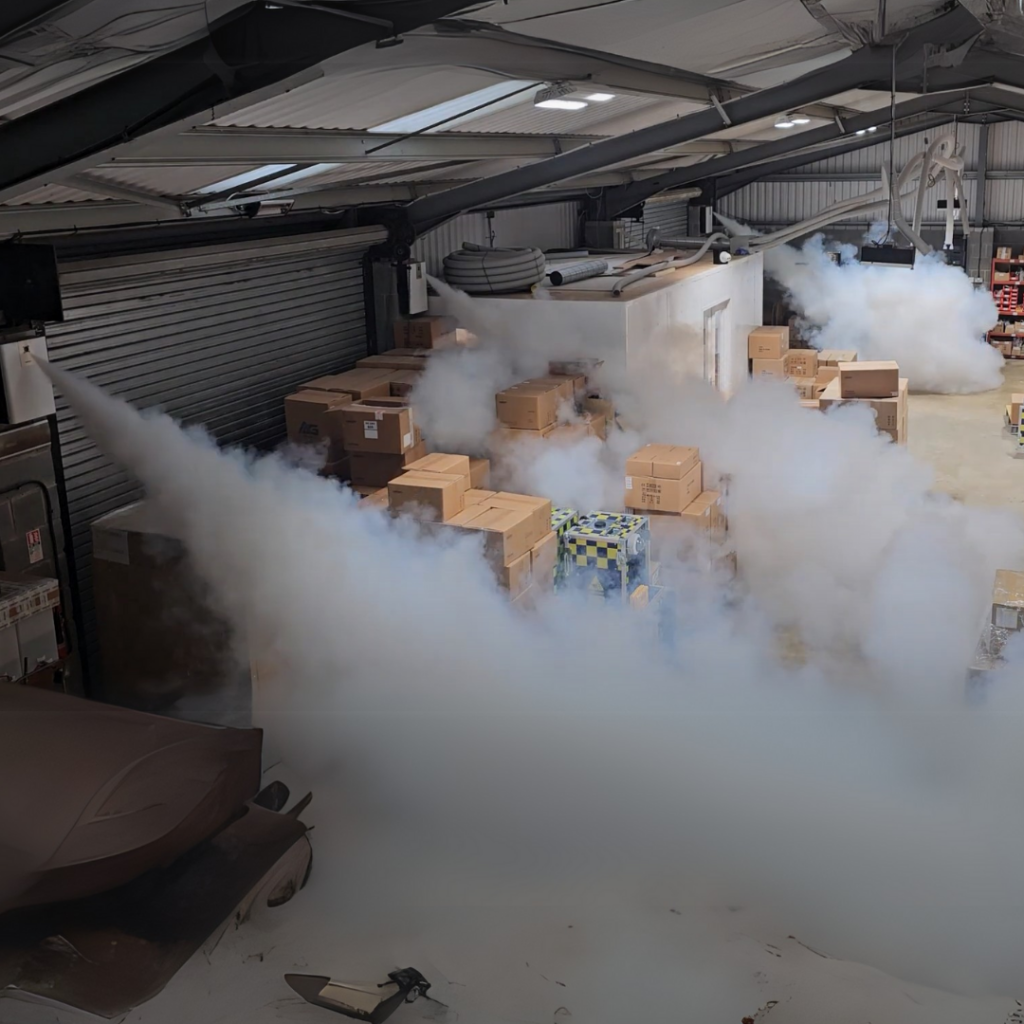
Security fog is produced by flash-vaporising a fluid of pharmaceutical-grade glycol and water through a heated exchanger — the certified consumable in every Sentinel is Fluid R Swift Fit. The vapour condenses into microscopic droplets that scatter light (that’s why it’s brilliant white) and hang in the air as an opaque cloud.
Two things it is not: it is not smoke (nothing burns, see security smoke vs security fog), and it is not a chemical agent — the same glycol family is used in theatrical fog, food production and medical inhalers.
Anecdotally we are often asked if we can make the security fog more dangerous. There is the obvious dislike for those who wish to intrude and steal or damage a property and so the idea of inflicting harm can be quite common. In other territories some suppliers use pepper spray instead of, or within the fog. At Smoke Screen we do not offer this solution as we believe that security fog without any further irritants is enough of a deterrent.
We don’t do this for a number of reasons. Firstly, having an irritant can cause problems if you wish to deploy the fog in more situations. Panic activations for example, are common in spaces like jewellers. Being high risk and so are more likely to face intrusion in the day. As you can imagine this means that there will be staff inside and may even be customers too. Imagine firing the security fog to repel intruders but in the process, you cause extreme discomfort to your staff or customers. Not a good look.
Secondly, in our professional opinion the security fog is hugely disorientating in its standard form alone and the panic is enough to send the intruders running. However, if you really want to take your security fog to the next level, we advise adding in additional disorientation layers such as a siren or strobe.
Safe for people?
Yes. The fog is breathable, non-irritant and deploys at safe temperatures. Certified systems are designed for occupied premises — shops with staff, homes with families. Being caught in the fog is disorienting because you can’t see, not because of anything the fog does to you; staff protocols are simply “stay put or move to the known exit”. EN 50131-8 — the standard our systems certify against (see our accreditations) — exists precisely to govern safe deployment characteristics: fluid safety, temperature, output behaviour (plain-English standards guide).
Children, pets, vulnerable people: the same answer — non-toxic and breathable. Sensible design keeps discharge nozzles positioned away from cots and cages so startle (noise/surprise), not chemistry, is the only consideration.

Safe for stock, furnishings and electronics?
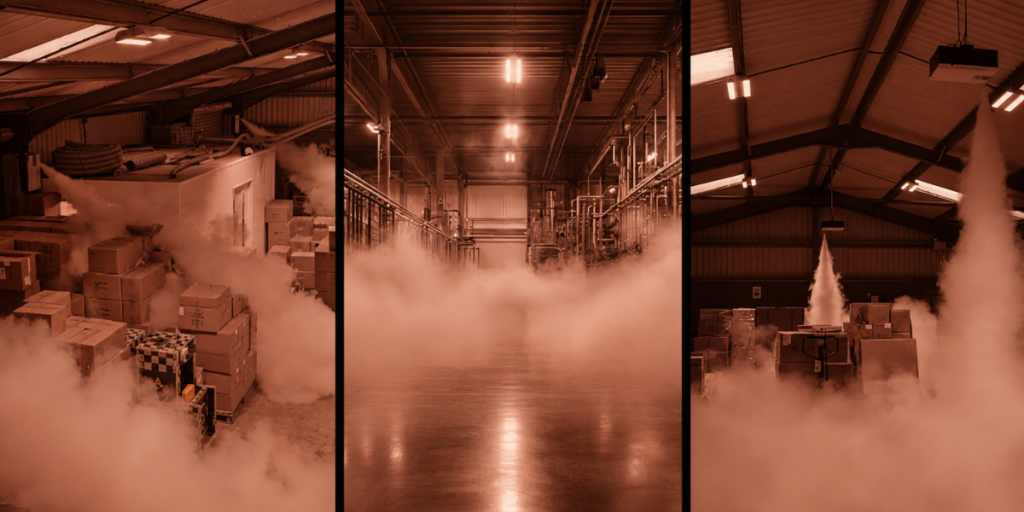
Yes — this is the commercial make-or-break, and it’s the most-tested claim in the category. The fog is dry: droplets are so small they don’t wet surfaces, don’t stain fabric, don’t mark packaging and leave no residue when the room clears. That’s why it protects:
- Retail stock — clothing, cosmetics, food packaging, electronics on open shelves (retail security; Boots ran it across 200+ stores — case study)
- Server rooms and IT — the fog is non-conductive and safe around running equipment (office security)
- Food environments — deployed by dairy giant Arla with zero losses since installation
- Homes — sofas, electronics, artwork (home security)
After an activation: ventilate, wipe nothing, restock nothing — trade resumes the same morning.
Will it set off fire alarms or sprinklers?
Sprinklers: no. Sprinkler heads are triggered by heat (a fusible element), not by particles — security fog is cool and cannot activate them.
Smoke detectors: it depends on the detector. Optical smoke detectors sense airborne particles and can respond to dense fog; heat detectors won’t. This is a design consideration, not a safety problem — installers coordinate with your fire system (zone isolation timed to confirmed intruder activation, detector choice in fogged zones) exactly as they do for the intruder alarm integration itself. Tell your fire-alarm maintainer a fog system is fitted; it’s a five-minute configuration conversation. And, in all honesty, if you are being robbed then the fire alarm also going off might be the least of your considerations.
| Concern | Verdict | Why |
|---|---|---|
| Breathing it | ✅ Safe | Food-grade glycol + water vapour, non-toxic, non-irritant |
| Children & pets | ✅ Safe | Same chemistry; position nozzles sensibly |
| Stock & fabrics | ✅ Safe | Dry fog, no residue, no staining |
| Electronics & servers | ✅ Safe | Non-conductive, non-wetting |
| Sprinklers | ✅ Won’t trigger | Heat-activated; fog is cool |
| Optical smoke detectors | ⚙️ Configure | Coordinate zones with fire system at install |
| Legality (UK) | ✅ Legal | EN 50131-8 certified intrusion component |
FAQ
Courtney Tupper